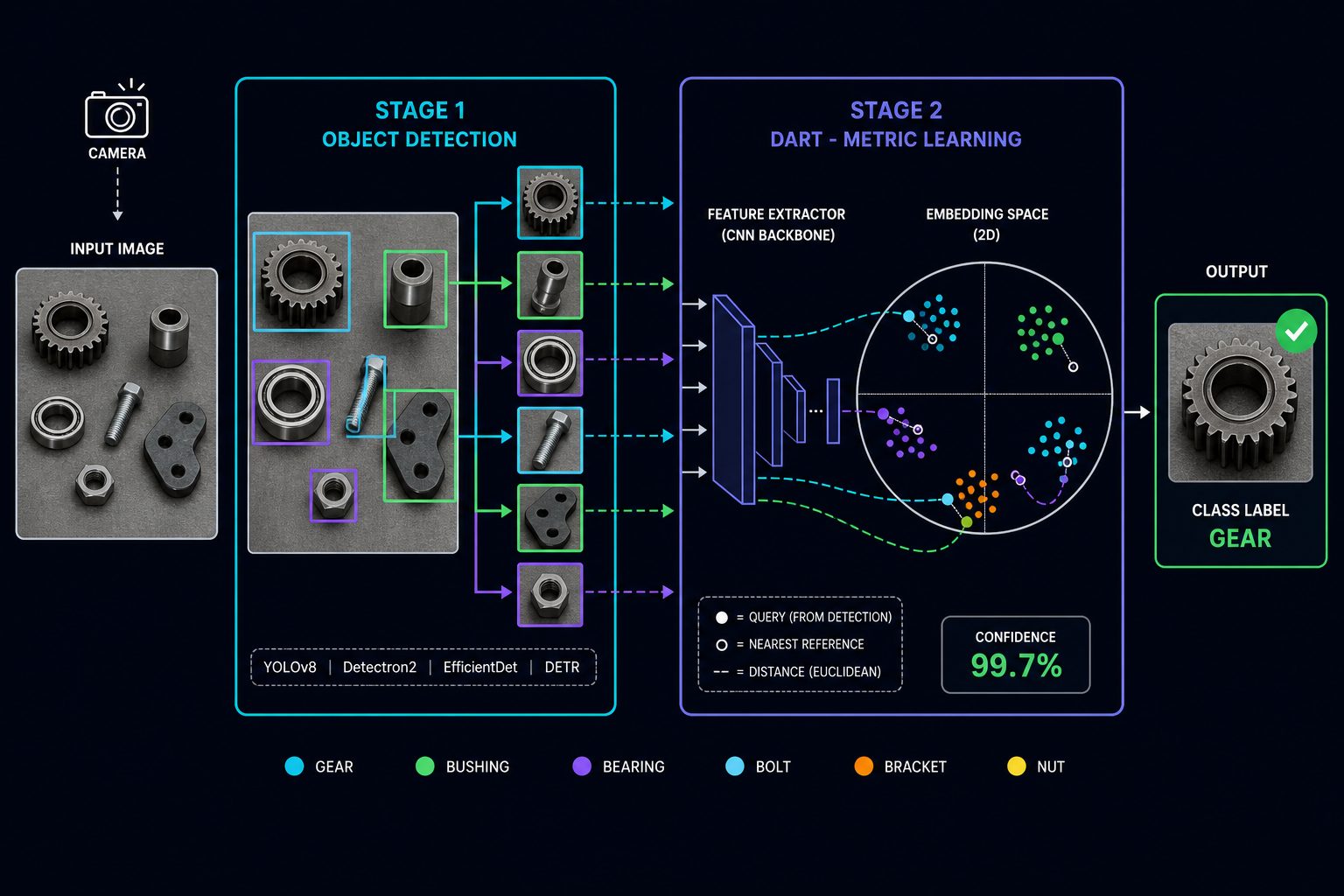
Proprietary metric learning layer applied on-top of object detection pipelines (YOLO, Ultralytics, Detectron2, EfficientDet, DETR). Drastically reduces training samples and delivers extreme precision during inference for visual identification.
DART operates as the second stage of a computer vision pipeline. The first stage — a detector based on architectures such as YOLO, Ultralytics, Detectron2, EfficientDet or DETR — localizes objects in the scene, producing bounding boxes and crops. The second stage is DART: a proprietary metric learning module that projects each crop into a high-dimensional embedding space.
In this vector space, each object's identity is resolved via nearest-neighbor retrieval against a database of reference embeddings. The result is an identification — not a classification — with configurable confidence thresholds and native rejection of unknown elements (open-set recognition).
Request a demo

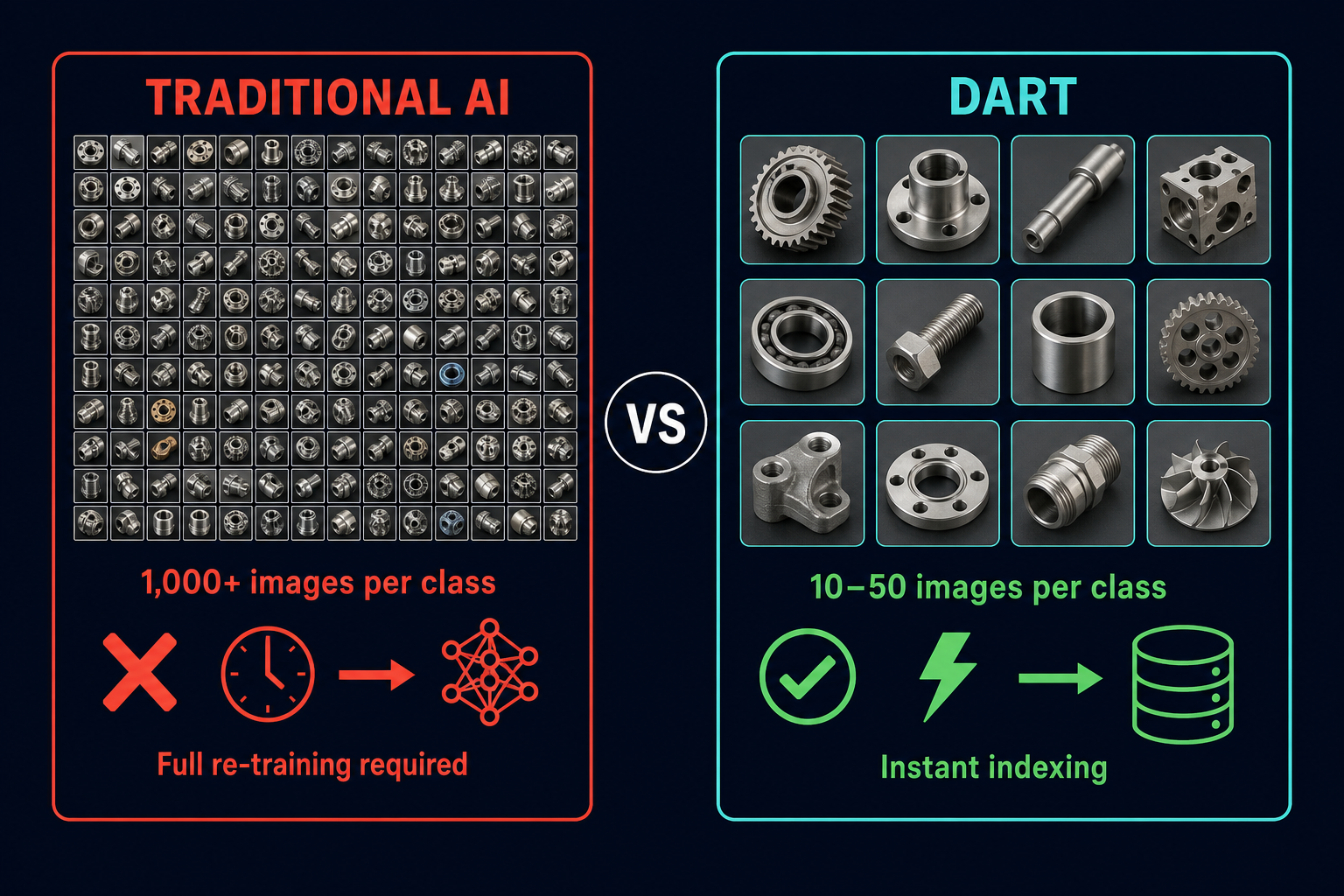
Traditional AI (CNN/ViT classifiers) requires hundreds or thousands of annotated images per class and a full re-training cycle for every new category. DART flips this paradigm through few-shot metric learning.
The feature extraction backbone is pre-trained once. Adding a new class means providing around a dozen reference images: DART generates their vector embeddings and indexes them in the database. No fine-tuning, no re-training, no downtime. New classes are available in real time.
Six technical properties that set DART apart from traditional classifiers at inference time.
DART does not assign probabilities distributed across N classes. It measures distance in embedding space and identifies by proximity: if no reference is close enough, the object is rejected. Structurally zero false positives.
Inference complexity is independent of the number of classes thanks to ANN (Approximate Nearest Neighbor) indexing. Same latency and accuracy with 100 or 100,000 classes.
Configurable similarity threshold on cosine distance. Unknown or out-of-domain objects are natively rejected, without artificial “other” classes.
The embedding space learns invariance to rotation, scale, lighting and background. Stable feature descriptors even in uncontrolled operational conditions.
Pipeline optimized for real-time inference. Detection + embedding extraction + retrieval in a single forward pass, compatible with edge and cloud deployment.
Confidence thresholds, maximum distance and top-K retrieval configurable per use case. Balance precision vs. recall with a single parameter.
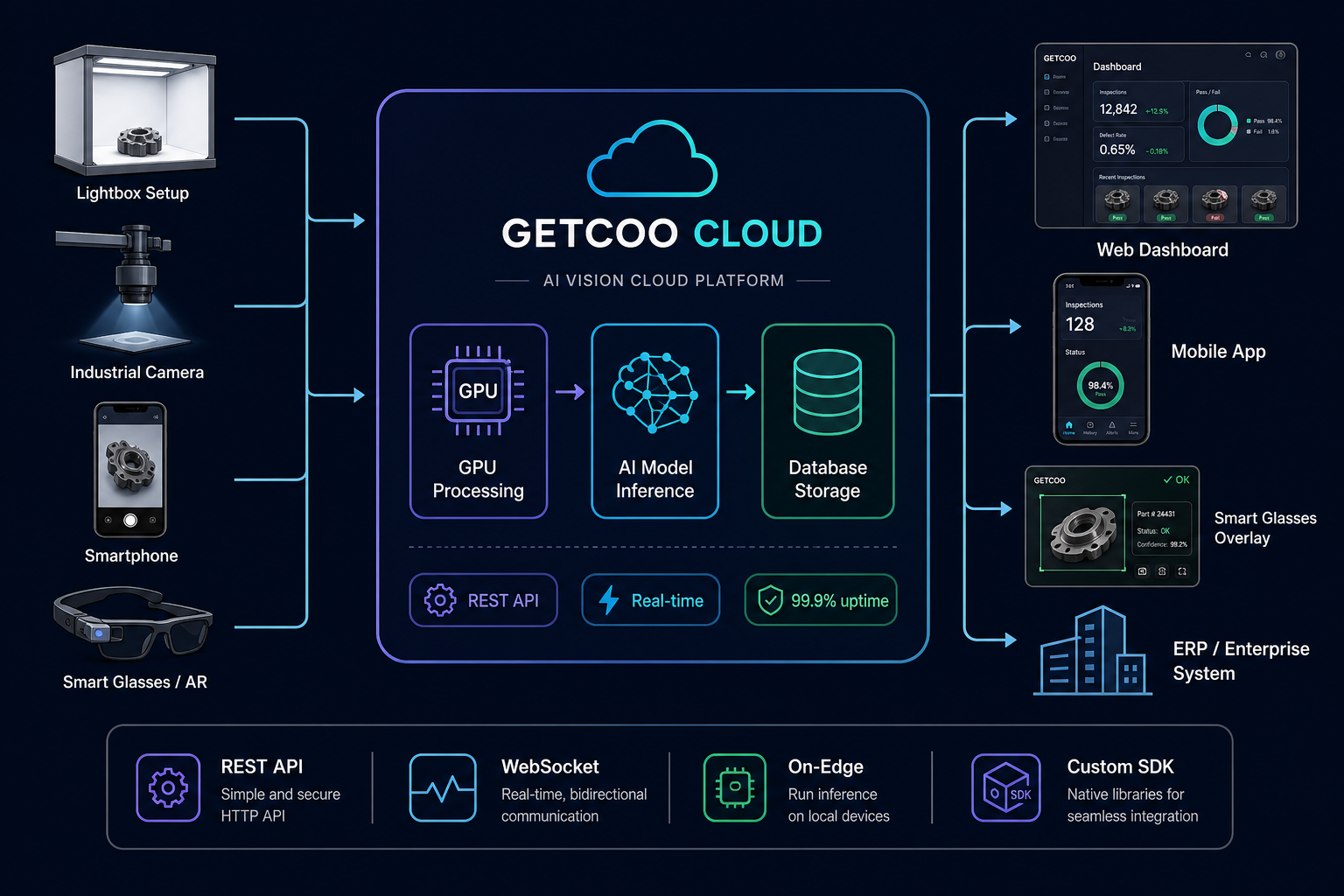
Images are acquired from different systems — lightbox, cameras, smartphones — and sent to our cloud for processing. Results are returned in real time via API.
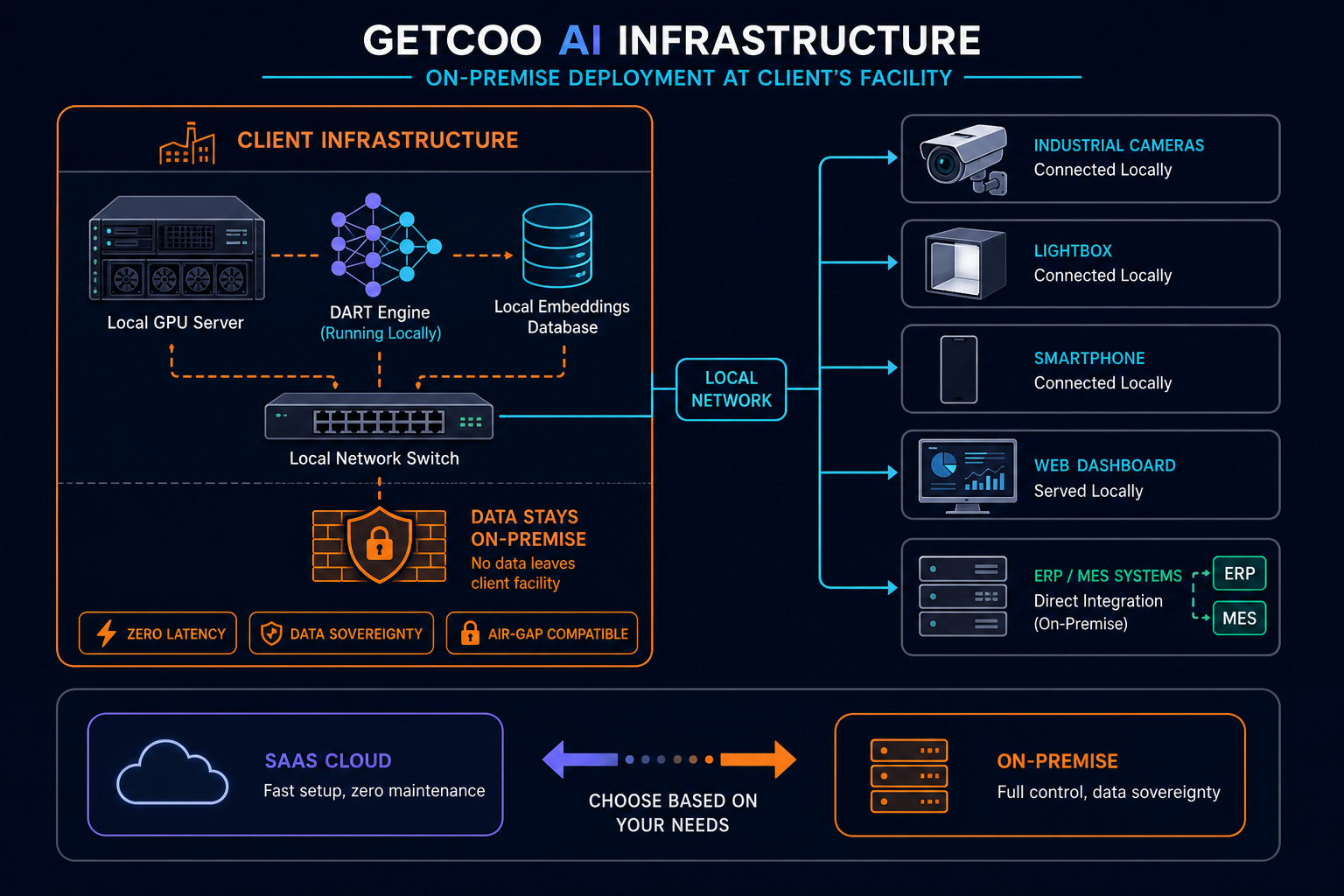
For environments with strict security requirements or minimal latency needs, the entire GETCOO infrastructure — DART engine, embeddings database, dashboard — is deployed on-premise at the client's facility.
Contact us for a personalized demonstration
of our AI technology.